
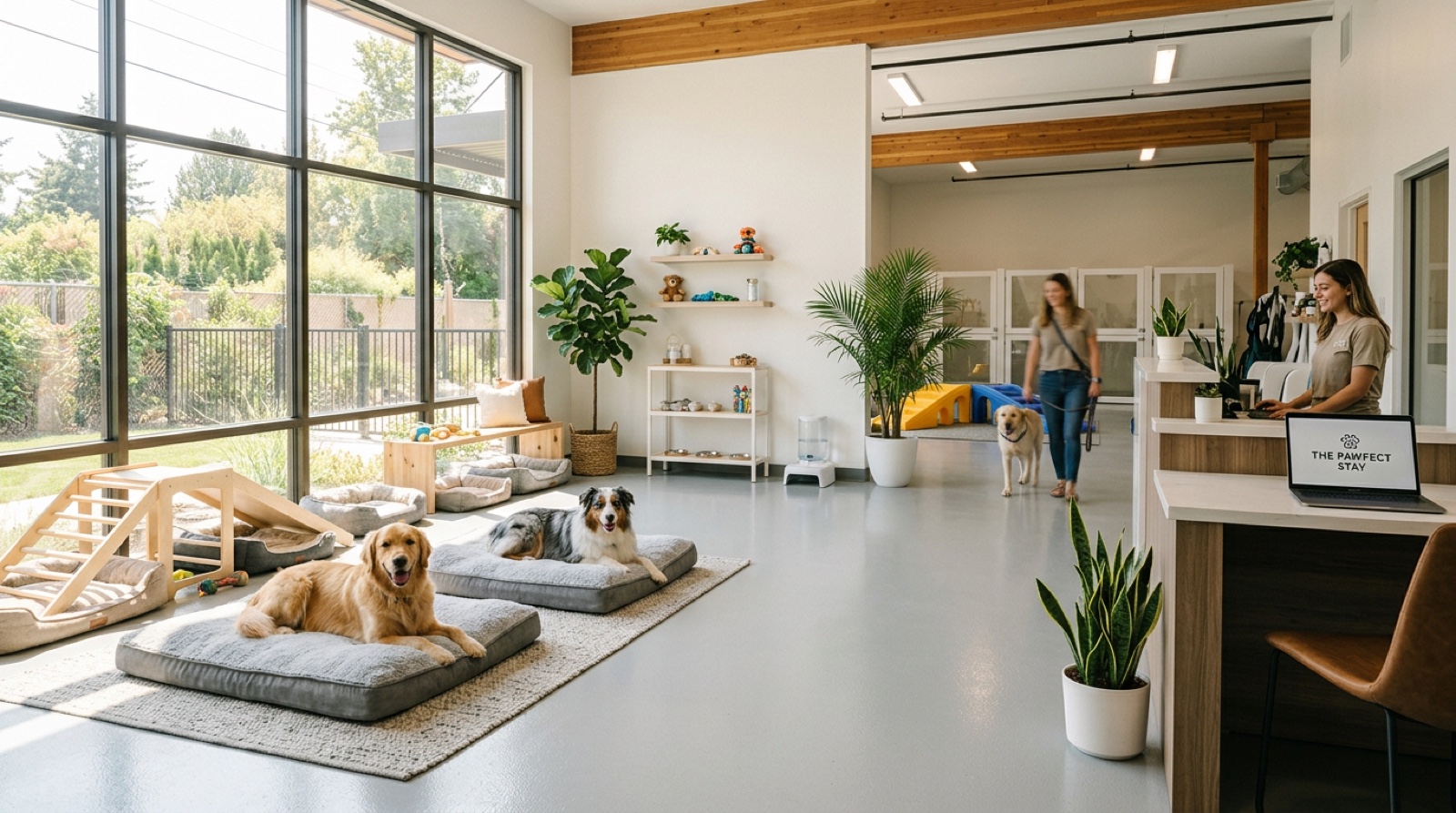
The most revealing question you can ask is this: how many dogs is one staff member responsible for, and who is on site between 10 p.m. and 6 a.m.? A facility that answers with a specific number and a specific overnight arrangement is running a real system.
A facility that answers with "we always keep an eye on them" is not. Every other question below builds on that first one.
Supervision: Get a Number, Not a Reassurance
Group play only works when someone qualified is reading the room. Ask what the ratio is during peak play hours, not the average across a slow Tuesday.
Then ask what happens overnight. There is a real difference between staff sleeping on the property, staff doing scheduled checks, and cameras that nobody watches until morning.
Useful follow-ups:
- Are dogs ever left completely unattended during play?
- How often are group sizes reshuffled during the day?
- What is the rest schedule, and where do dogs decompress?
- Can I see the space where my dog sleeps, not just the lobby?
Staff Training and Who Is Actually on the Floor
Certifications matter, but so does turnover. Ask who handles your dog day to day and how long that person has worked there.
Look for training in canine body language, group play management, and pet first aid or CPR. Programs from organizations like the Professional Animal Care Certification Council or Fear Free are a good sign that the staff learned to read stress signals before a scuffle starts.
Questions worth asking directly
- What training does a new hire complete before supervising a group alone?
- Who is certified in pet first aid, and is that person always on shift?
- How does staff break up tension between dogs, and what tools do they use?
Emergency Protocols You Should Confirm Before Booking
Ask what happens if your dog is injured at 2 a.m. on a Sunday. The answer should include a named emergency veterinary hospital, a transport plan, and a spending threshold that triggers a call to you.
Central Texas adds two specific risks worth raising. Summer heat here regularly climbs past 100 degrees, and severe weather can knock out power for hours.
Ask how outdoor play is limited during heat advisories, whether there is shaded and cooled space, and what the plan is if the building loses electricity. A Round Rock facility that has thought through an August afternoon has thought through most things.
Ask What Cage-Free Actually Means at That Location
Cage-free is used loosely. Some facilities mean open play all day with sleeping areas, and others mean crates that they call suites.
Ask what percentage of the day a dog spends in an enclosed space, and what the sleeping setup looks like. Our own approach to overnight boarding in Round Rock is built around open living space rather than runs, and it is fair to ask any facility to show you the same thing in person.
If you want the longer explanation of why this matters for anxious or high energy dogs, we covered it separately in our guide to cage-free care.
How Dogs Are Grouped and Screened
Every dog in the building affects your dog. Ask whether there is a temperament evaluation before the first stay and what disqualifies a dog.
Then ask how groups are formed. Size, energy level, play style, and age all matter more than breed.
A trial day is the cleanest way to test this. Many owners start with a few daycare visits before committing to a week away, which gives staff a baseline on your dog and gives you a report to judge them by.
Health Requirements Signal How Careful They Are
Loose vaccine rules are a warning. A facility that will take any dog on the same afternoon is not protecting the dogs already there.
Expect rabies, DHPP, and Bordetella at minimum, with proof required from your veterinarian. Ask about canine influenza policy and how they handle a dog that starts coughing mid stay.
| Question | Strong answer | Warning sign |
|---|---|---|
| Staff to dog ratio at peak | A specific number with group caps | "It depends" |
| Overnight coverage | Named arrangement and check schedule | Cameras only |
| Emergency vet | Specific clinic and transport plan | "We would call around" |
| Cage-free definition | Shown in person during a tour | Only described over the phone |
| Vaccines | Records verified before arrival | Accepted verbally |
References and a Tour on Your Schedule
Ask for two or three local references, ideally owners with a dog similar to yours. Reviews from Pflugerville, Hutto, and Cedar Park clients tell you more than a star rating, because those owners drove past other options to get there.
Then ask to tour during business hours without a long lead time. A facility that needs a week to prepare is preparing.
While you are there, watch the dogs rather than the decor. Loose bodies, normal play interruptions, and staff who redirect early are worth more than clean paint.
Logistics That Matter Around Round Rock
Ask about drop off and pickup windows, and whether weekend hours change. If you are driving in from Georgetown or Leander during rush hour on I-35, a narrow pickup window can turn into an extra night of boarding.
Also ask what is included in the nightly rate. Feeding, medication administration, and extra one on one time are sometimes billed separately, and you want that clear before you book a holiday week.
Put the List to Use
Take these questions to two or three facilities and compare the answers side by side. The gaps show up fast.
If you want ours answered directly, get in touch for a quote or to schedule a tour and we will walk you through supervision, emergency procedures, and pricing without the sales pitch. You can also call (737) 201-1569 and ask anything on this list.